

Customer Service Week: Thank You for Trusting Home Afrika With Your Property Journey
October 08, 2026
For years, property buyers looking for opportunities outside Nairobi’s established neighbourhoods have followed the same pattern: identify where the city is expanding, study the infrastructure being developed around it, and get positioned before demand catches up.
Today, Koma is increasingly attracting attention as part of the wider Nairobi metropolitan growth corridor.
Located along the Kangundo Road network and connected to the Koma–Kenol Road, Koma sits within a corridor linking Nairobi’s eastern outskirts with growing centres such as Ruai, Kamulu, Malaa, Joska, Tala, Kangundo and onward toward Machakos and Konza. A government strategic plan identifies Koma as one of the key centres along the Ruai–Konza transport corridor.
For land buyers, the important question is not simply whether Koma is developed today.
It is:
What is Koma becoming?
Koma's Strategic Location Is Part of the Story
Property value is rarely determined by a location in isolation.
It is influenced by how easily people can reach that location, what is being developed around it, the services available to residents and businesses, and whether the wider area is attracting population and economic activity.
Koma benefits from its position within the broader Kangundo Road growth corridor. The corridor connects several emerging residential and commercial centres and provides links toward Nairobi, Machakos and Konza.
That connectivity matters because property demand tends to follow movement.
As people look for alternatives to higher property prices and congestion in established parts of Nairobi, satellite towns and emerging corridors can become increasingly attractive for residential development and investment.
Koma is positioned within that larger story.
Infrastructure Can Change the Investment Equation
One of the biggest factors to watch when evaluating an emerging property market is infrastructure.
Roads do more than make an area easier to access. They can influence where homes are built, where businesses open, where services are established and how quickly previously underdeveloped areas become integrated into the wider metropolitan economy.
The wider Kangundo Road corridor has experienced significant infrastructure attention over the years, while the Ruai–Konza strategic corridor specifically includes Koma and the Koma–Kenol connection.
Recent government action along the Kangundo Road corridor has also focused on clearing unauthorised developments from road reserves, including areas around Koma, as part of protecting and improving the transport corridor.
For investors, this highlights an important lesson:
Don't only look at what exists around a plot. Study the infrastructure shaping what can exist there in the future.
From Residential Land to a Growing Community
Koma's opportunity is not simply about selling plots.
It is about the potential for a community to develop around them.
As residential populations increase, demand for everyday services follows. Shops, schools, commercial centres, rental housing, healthcare services, restaurants and other businesses become increasingly important.
This is already visible across the wider Kangundo Road corridor, where residential development has been accompanied by commercial activity and new housing.
The relationship is straightforward:
More residents → more demand → more businesses → more services → a stronger local property market.
That does not guarantee that every plot will appreciate at the same rate. But it explains why investors should study the direction of development rather than simply today's appearance.
Why Early Positioning Matters
There is a fundamental difference between buying land because it is cheap and buying land because you understand its future positioning.
An inexpensive plot in an area with weak connectivity and little development may remain inexpensive.
A strategically positioned plot within a growing corridor can have a very different investment proposition.
This is why experienced property buyers examine factors such as:
Koma's location within the wider Nairobi–Machakos growth network makes these factors particularly important.
The Koma–Kenol Connection Adds Another Layer
One of the defining characteristics of Koma is its connection to the Koma–Kenol road network.
The wider Ruai–Konza strategic corridor connects Koma with a chain of centres extending from Ruai through Kamulu, Joska, Malaa and Koma toward Kenol, Machakos and Konza.
That creates an interesting investment dynamic.
Instead of looking at Koma as an isolated town, investors can look at it as one node within a much larger development corridor.
And that is an important distinction.
The strongest emerging property markets are often not created by one development. They emerge from the interaction of roads, people, businesses, housing, infrastructure and investment across an entire corridor.
What Should You Look for When Buying Land in Koma?
If you are considering buying land in Koma, don't make the decision based on price alone.
Ask five questions:
1. How accessible is the property?
A plot's exact position relative to tarmac roads, access roads and established centres can make a major difference.
2. What is being developed around it?
Look for evidence of actual development rather than relying entirely on promises.
New homes, schools, businesses, roads and other infrastructure can tell you more about an area's trajectory.
3. Who is the future buyer?
Consider whether the location is likely to attract homeowners, rental developers, businesses or long-term land investors.
4. Are the fundamentals right?
Check documentation, access, planning, utilities, zoning and the physical characteristics of the land before committing your money.
5. Where could the area be in five to ten years?
This is perhaps the most important question.
You are not only buying what Koma is today. You are buying a position within its future growth story.
Noble Park Estate 2: Positioning Yourself in Koma
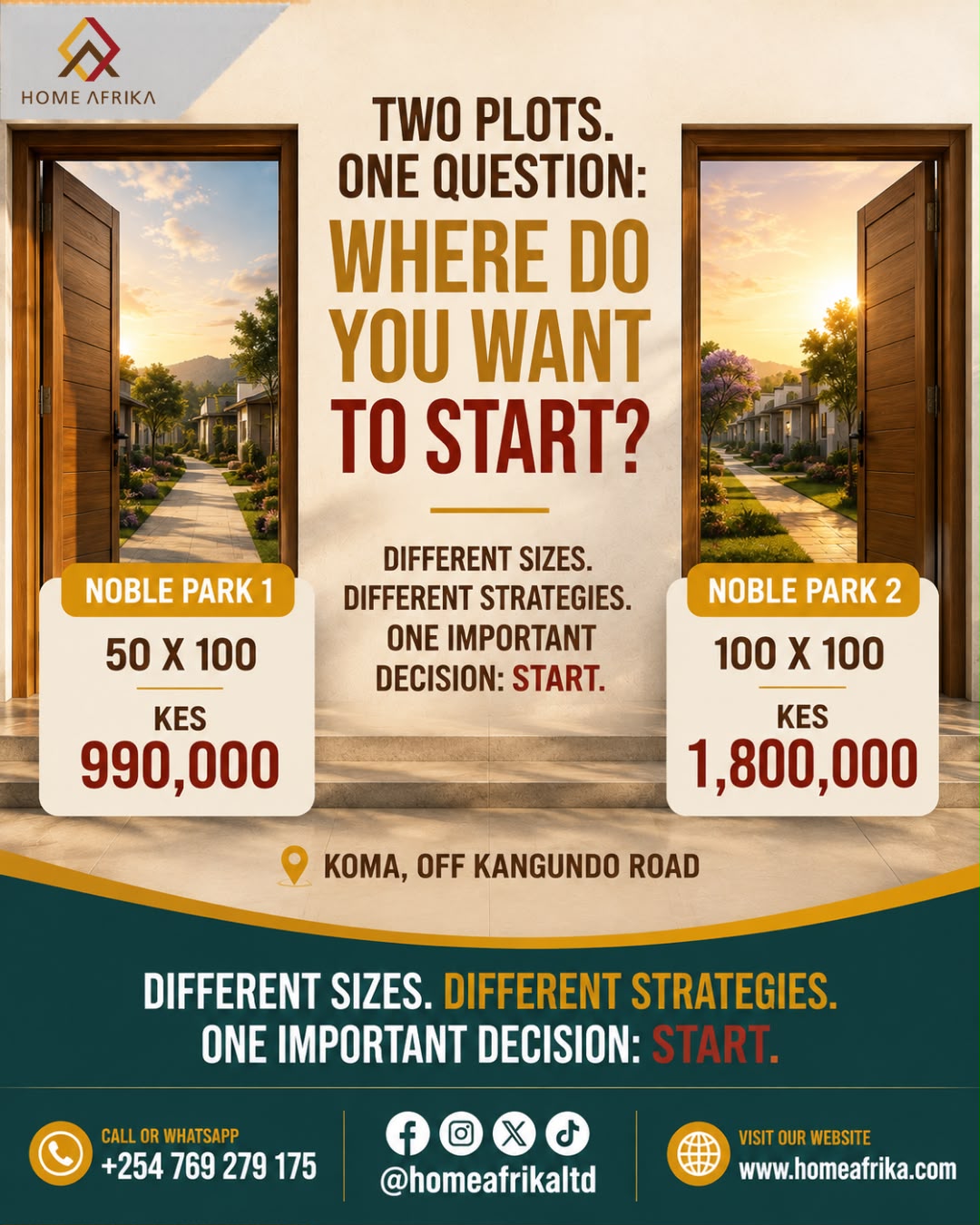
For buyers looking to take a position in this emerging corridor, Noble Park Estate 2 by Home Afrika is located in Koma Town, off Kangundo Road and approximately 200 metres from the Koma–Kenol Road.
The project offers ¼-acre and 100×100 plots, with the current listed price at KSh 1.8 million.
The development is positioned near Koma's growing commercial centre, with electricity and water available near the tarmac and an international school nearby. The area also offers views toward Lukenya Hills, Mua Hills and Koma Hills.
The proposition is therefore not simply about owning a piece of land.
It is about securing land within a developing residential corridor while considering the infrastructure, amenities and population growth shaping the surrounding area.
Is Koma a Good Place to Invest in Land?
Koma deserves attention because it sits within a wider corridor experiencing residential, commercial and infrastructure development.
But smart investing requires more than following a property trend.
Location matters. Positioning matters more.
Before buying, investigate the exact property, verify ownership and documentation, understand the access and infrastructure, and study what is actually happening around the land.
Because the biggest property opportunities are rarely obvious after everyone has arrived.
They become obvious because someone studied the direction of growth early.
Looking for Land in Koma?
Home Afrika's Noble Park Estate 2 offers ¼-acre and 100×100 plots in Koma Town, off Kangundo Road.
Price: KSh 1.8 million
📍 Koma Town, off Kangundo Road
📞 0769 279 175
📧 [email protected]
🌐 www.homeafrika.com
Better locations. Better decisions. Better returns.